Thursday, September 16, 2010

Update from Today -- CT Scan, Etc.

First of all, THANK YOU to everyone who was praying today!!! Your prayers were answered, and everything went very smoothly and was very informative.

We went in around noon for Addy's CT scan. Since Addy had been up all morning and I figured she would sleep in the car for the whole 45-minute drive, I was about 90% convinced that she was going to need to be sedated for the procedure. When we got there, however, she was wide awake. I'm still not sure whether she slept in the car or not (she was completely silent the whole time).

In either case, she was acting tired and very hungry by the time we got to the waiting room. I had not been allowed to give her anything except a few ounces of water for four hours, so it was no wonder. When one of the nurses saw how Addy was acting, she suggested that maybe I could just nurse her to sleep for the procedure. That sounded good to me, but then another nurse explained that if we did that and it didn't work, we would not be able to use the sedation method, since they have to have an empty stomach for that. In other words, we would have to reschedule if Addy didn't go to sleep after nursing.

Based on how Addy was acting, I decided to take the chance. I know some of you must have been praying for Addy not to have to be sedated (I was, too), because she fell asleep like a charm and stayed perfectly still while the scan was done. No drugs needed -- YAY! The results were great.

Afterward, Addy and I went to see the same doctor (Dr. M) with whom we spoke last time we went to Duke. I had several questions on my mind that I wanted to address, the foremost being whether or not there were any surprises that showed up on the CT scan. Thankfully, there were not. The scan showed a right coronal synostosis (as we already knew), and all other sutures look open and normal. Also, the doc showed me how there was plenty of fluid (i.e. space) between her brain and her skull, so there is no indication of intra-cranial pressure -- a concern of mine, since that can cause headaches and potentially brain damage if it is bad enough. As Dr. M put it, "That is a very comfortable brain." With that in mind, there should be no problems waiting until November to have the surgery.

The remainder of my questions mostly related to the following:

1) Is there anything wrong with her eyes that will need to be corrected in some way beyond the cranio surgery? (If you remember, she has one eye that tends to deviate slightly from the other.) What about her neck / head tilt?

2) Addy has a small, pea-sized lump on the back of her head that I noticed a few weeks ago. What is that, and is it related?

3) What exactly is the road map for the surgery -- i.e., how will you proceed?

The third question was probably the easiest to answer. Dr. M went over exactly what he would be doing during the surgery -- which pieces of bone he would be removing, how he would re-shape them, how he would put it all back together, and what materials he would be using to hold it in place. It was rather fascinating, so long as I didn't think too much about the fact that this would be happening to my baby's head in the near future! Thankfully, it sounds like Addy should have a well-built head and face that should be able to withstand the bumps and bruises she is sure to incur during toddler-hood. (Once she gets past the first 12-15 months post-op, the materials used in the surgery should all be dissolved and it will be her own bone anyway, so not much different than a normal child's head.)

The second question ended up being inconclusive. Dr. M felt the lump and mentioned the possibility that it could be a small cyst on another of her suture lines (which he said happens sometimes -- unrelated to the craniosynostosis). When he looked at the CT scan, however, he couldn't find any evidence of it. He had the radiologist look over it as well, with the same result. So, we are still not sure what the deal is with that. Dr. M said he would look over the scan again and let us know. If it is a cyst, Dr. M made it sound like a fairly simple procedure to get it removed.

The answer to the first question was very informative, though not necessarily all that encouraging. Dr. M said that in about 10% of coronal cases, children will have some kind of strabismus, or lack of eye alignment. He explained that this is because the bones of the head have grown abnormally, and so the muscles of the eye are not quite in the right place. They can be looser than they are supposed to be, so the eye tends to drift a little where the muscle is weak. Sometimes this happens to be corrected with the cranio surgery, but that is pretty rare. Other times, it can be fixed with a regimen of eye patching, to help the muscle strengthen and tighten itself. If that doesn't work, another surgery may be required to tighten the eye muscle. If so, it would probably have to happen as soon as possible after the first surgery heals enough (which should be around 4-6 weeks), since it can cause permanent vision problems if left uncorrected.

As for the head tilt, Dr. M didn't think it was serious enough to need any medical attention, so that at least was a relief.

With these things in mind, here are our current prayer requests:

1) That we would be able to find out what the lump on the back of Addy's head is and get it resolved without too much trouble.

2) That we would be able to get Addy's eyes taken care of as easily as possible and in such a way that her vision would be preserved. Obviously, it would be AWESOME if the cranio surgery would just fix this problem right off, but please pray that the eye patching would work if that is not the case. If she does need further surgery, please pray that we would be able to get through all that as well. Specifically, it would be really nice to get that surgery done before the end of the year, if it is necessary, since we will already be paying our yearly out-of-pocket limit for the other surgery and would have to do it all over again if we had to wait till next year! (This same request would be true if surgery is required for the lump on her head as well.)

Obviously the fewer surgeries, the better, so please be praying that we could get everything resolved in as few surgeries as possible!!!!

3) That God would strengthen and equip us, the doctors, and especially Addy for the days ahead. Please be praying that all would go smoothly, with no complications, and that Addy would do well and heal quickly.

And as a reminder, the surgery is scheduled for November 12th. Please be praying for that date.

Thanks so much again for following along and praying for all this!!!

Thursday, August 26, 2010

Another Appointment

Now that we have a surgery date set, I have been re-thinking and second-guessing our decision a little bit. This is mostly because I have been watching Addy ever since her diagnosis and seeing that the asymmetry of her head is getting a little worse (which is to be expected, since the head may not want to grow correctly, but the brain keeps getting bigger regardless!). And also, more significantly, I have been noticing that she is not quite as happy and content a baby as she once was. I wonder whether she is suffering from headaches, which is not as likely for a baby with only one fused suture, but is still possible. I have joined an online forum of parents (mostly moms) whose children have craniosynostosis, and a few of them have said they believed their children had the same thing. Some said their babies' moods were much more mellow or even completely different after the surgery was done!

So because of this, we decided to try to get her CT scan done a bit earlier than the surgeons were originally planning. Normally, they do it very close to the surgery date, just so they can get an up-to-date road map for the surgery, so to speak. However, it is not completely necessary to wait that long, and I will feel a lot better if we can determine that it will not be dangerous or miserable for Addy to wait until November for her surgery. I have it on good authority that if for some reason the CT shows that her brain is under pressure (causing the headaches) or something else to show that she needs surgery earlier, they will make it a priority to get Addy in as soon as she needs. Her doctor normally likes to do these surgeries when the baby is around 7 months old, but we will see if that is best for Addy or not. Our CT scan and then appointment with Dr. M are scheduled for Sept. 16, three weeks from today.

We would appreciate prayers for this appointment. We want the CT reading to be as good / accurate as possible, so Addy will need to be very still -- either asleep or under some mild anesthesia. Natural sleep would obviously be preferred, but please be praying that God would allow whatever is best to get a good scan. Please also pray for our appointment with the doctor -- that we would be able to get our questions answered and determine whether the date in November will be the best date for her surgery.

On another note, I have been finding some great advice and encouragement from the moms on the online forum mentioned above! It is really nice to be able to talk with other moms who have dealt with the same things that we are going through, and to receive help from them about what to expect, what to watch for, questions to ask, etc.

Oh, and by the way... I don't remember if I mentioned this before, but Addy also has a bit of a head tilt, and her left eye drifts a little bit to the outside and down from the other eye. I used to think the head tilt was just because the left side of her head is bigger (and thus heavier), and it might just be the weight of it that is causing her to tilt her head. Several of the moms mentioned that their children had the same issue, though, and in some cases it seemed possible that it wasn't really related to the craniosynostosis (although some of the moms did specifically say that it got better after the surgery). Several of them also mentioned eye problems, which could very well be related to the head tilt... I have heard both that the head tilt can cause the eyes to set themselves differently so the baby can see clearly, and vice versa -- that the eyes can be misaligned and cause the baby to tilt his/her head to level out the eyes. I am not sure that either of these is the case for Addy, but I do suspect that the two are somewhat related. I have heard that giving her more tummy time can at least help the neck issue, and since I have been encouraging that, both the head tilt and the eye issue seem to have improved a little.

In any case, please be praying that we can figure out what is causing both these issues and get them resolved.

Thanks to everyone for all your prayers and support!!!

Saturday, August 21, 2010

Surgery Date...

...is scheduled for November 12. Other details to follow in the coming weeks.

Thursday, August 12, 2010

FYI

Just in case anyone is wondering, I have still not heard when the surgery date will be. The woman who schedules these things did not contact me by the end of last week, and I didn't know until I called yesterday that she is apparently on vacation all this week. :-p So hopefully I will know sometime early next week. If they don't call me, you can bet I will be calling them. ;-)

Wednesday, August 4, 2010

Choosing the Open Procedure

Update, short version: We have decided to abandon the endoscopic option and have the traditional open surgery for Addy. The operation will be at Duke hospital, most likely sometime in November. We should be receiving dates for the surgery and pre-op appointments by the end of this week.

And now for the long version...

We went to Duke for a consultation with Dr. M (the pediatric plastic surgeon) this past Thursday. We also had a short talk with Dr. G, the pediatric neurosurgeon with whom Dr. M performs these surgeries. Dr. M examined Addy and looked at her x-rays to confirm the diagnosis of craniosynostosis -- which he did, to no surprise. He then took some time to explain to us a little more about craniosynostosis, what the traditional surgery is like, and how it compares to the endoscopic procedure. To our surprise, he was relatively familiar with the doctors in San Antonio whom we were considering (Dr. G had actually worked in the same hospital with them for a time), and his review of them was not altogether negative. In fact, he said that if Addy's case had been a saggital synostosis (down the middle of the head), he might have actually encouraged us to go the endoscopic route. He said he was almost convinced that he should start using this method himself. For coronal synostosis like Addy's, however, he still believes that the traditional method provides the best results.

Here are the main differences between the procedures. The endoscopic surgeon makes two incisions -- one in the middle of the head and one near the ear, for Addy's case -- of about 1.5 to 2 inches in length. They then remove a small piece of the bone along the place where the two plates have fused together, to release the fused point. Afterwards, they use a specially fitted helmet to encourage the head to grow in the right shape. This helmet must be worn 23 hours a day for approximately 12 to 18 months, with refittings approximately every 3 months.

In the traditional procedure, the neurosurgeon makes an incision from ear to ear (zig-zagged to make the scar less noticeable under the hair). They then actually remove the bones and hand them over to the plastic surgeon, who molds the bones into a more normal shape. Then they replace the bones and fill the gaps with dissolving screws and other materials to help keep the bones in place. A more symmetrical result will be noticeable immediately, and no helmet is required after surgery.

The biggest disadvantages that we could think of to the open procedure were having to wait to get the procedure done, length of surgery time (and time under anesthesia), common need for blood transfusion (because of blood lost during the surgery), length of stay in hospital, limitations on sports activity in the future (something new that came to my attention last week), and the general invasiveness of the procedure. Dr. M answered our questions as follows.

Having to wait: The open procedure is usually done between 6 and 8 months, while the endoscopic procedure essentially needs to be done ASAP, and definitely before 6 months. Part of the reason we liked the endoscopic option is because we were afraid that waiting that extra 3 months might be damaging to Addy's health. Dr. M explained, however, that even if we never had the surgery, it's very likely that Addy would be completely normal and healthy, albeit with a misshaped head. The growth of the brain is what determines the head shape, and if the growth is cut off in one direction by a closed suture, the brain simply continues to grow in whatever direction it can. In some cases (especially if more than one suture is closed), this can cause increased pressure in the brain, which can lead to headaches and even brain damage. However, Dr. M said that this only happens in about 10-15% of cases. So, unless he has reason to believe that Addy is suffering from one of these cases (which he did not say he did), it should not be harmful to Addy's health to wait the extra time.

Surgery time: The surgery time for the endoscopic procedure is normally about an hour in length, whereas the open surgery will typically take about 3-4 hours. While this does mean longer time under anesthesia, in the scheme of things, this really isn't that much longer. Or, as Dr. M put it, "it's not nearly as long as some of the other surgeries that we do here." There is always a risk under anesthesia, but Dr. M assured us that the anesthesiologists would keep a close eye on Addy and make sure that she is handling it all right.

Blood transfusion: First of all, Jeremy or I can donate blood specifically for Addy's surgery, to have on hand in case she needs it. Secondly, while this procedure does have a high rate of transfusions, this is not necessarily a bad thing. As Dr. M explained it, someone who is trying to advertise a low transfusion rate (such as the folks in San Antonio) may be inclined to push the limits a little further than necessary, just to keep their rates down. Not that they would push it to an unsafe level, but they might let it drop a little lower, instead of going ahead with the transfusion to try to make the baby feel better and more comfortable after the surgery. Dr. M told us that they will normally put a line in the baby and make the transfusion slowly over the process of the surgery, unless the baby is just doing great (with very minor bleeding) and looking like he/she doesn't need a transfusion at all. So while the amount of blood lost sounds scary, the transfusion process is safe and helps the baby feel more comfortable.

Length of stay in hospital: The typical stay after Duke's procedure is about 4 days, versus 1-2 days with the endoscopic team. While this will make the total more expensive, the cost to us will be no different, since we figure we will be paying up to the out-of-pocket limit on our insurance for either surgery. And while it won't be fun to stay in the hospital for that long, we would have spent at least that much time away from home and our other girls anyway, since we'd have to fly away to San Antonio. This way, we can at least make easy trips back home if we need to.

Sports activity: I had heard from another mom who chose the endoscopic procedure that, unlike children who had the open procedure, her child had no limitations for sports. Dr. M, however, said that an child who has had an operation such as this will want to avoid rough sports to avoid trauma to the head. He said that this is usually not as much of a problem for girls, since they are not usually going to want to play football or rugby. He did say that they are a little uncomfortable with soccer (which is one sport I would consider letting my children play), but it is not completely out of the question.

General invasiveness: When it comes right down to it, I think the main reason I was rooting for the endoscopic option was simply because I, as a mother, get pretty squeamish when I hear what is necessary for the open procedure. The thought of my baby's head essentially being taken to pieces and put back together, and of having her come out of surgery bandaged and bruised almost beyond recognition, is NOT something that makes me comfortable in the slightest. After talking with Dr. M, however, I have confidence that these are experienced surgeons who have performed this surgery many times. They know what they are doing, and they have had great success and few complications in doing it. Dr. M himself has been performing these surgeries for at least 8 years, not including his time in medical school, with about 30-35 cases a year. In all that time, he listed only a handful of complications, with the probably worst of them being an infected incision which required reopening and cleaning out. In other words, complications are very rare.

As I mentioned above, Dr. M seemed pretty familiar with the folks in San Antonio, and as he put it, if he thought that their method was really the best, he would already be doing it. Contrary to what I had assumed before our talk, the endoscopic method has been around for a fair amount of time as far as the medical world is concerned (about 10 years), and it is still not very well received by doctors around the country. Jeremy's cousin's wife, who is a doctor at Washington's Children's Hospital in Seattle (which is apparently one of the best places in the country for treating craniosynostosis), gave us some information from one of their neurodevelopmental pediatricians who has a number of patients with the condition. This doctor, like the doctors at Duke, felt that the open procedure was the best option.

Dr. G, who had worked near the doctors who perform the endoscopic surgery in San Antonio, provided a helpful perspective as well. Although he had good things to say about these doctors, he said that he would still recommend the open procedure, especially for unicoronal synostosis (i.e., fusion of a single coronal suture, from the middle of the head to the ear on one side, as Addy's is). Unlike the other forms of craniosynostosis, this is the only form that causes an asymmetrical misshaping of the head, whereas other forms will cause an abnormal but symmetrical shape. This makes it more difficult to achieve an aesthetically pleasing result, since we like to see symmetry on both sides of the head. For this reason, the open procedure will generally work better, because they are able to actually shape the bone, instead of using a helmet to hopefully help the bone to grow in the right shape. If for some reason the helmet didn't work, the child might need the open procedure down the road anyway, which would be far worse because the child would be older, more mobile, more aware of what was happening, and have harder (less malleable) bones.

Of course, as far as we could tell, this second surgery would not be entirely necessary (i.e., it would not be a threat to her health not to have it) -- it would just be needed to achieve a more aesthetically pleasing result. While this would make a difference, especially to a girl, it is not crucial, and did not factor largely into our decision. Essentially, what it came down to was the feeling that we were debating between two surgeries of approximately equal value -- one slightly more risky, but still very safe and effective. If one had presented itself as significantly superior to the other, we would have gone with it. But in the absence of a clear-cut winner, we had to factor in the elements of cost and convenience. And with the necessity of plane trips to and from San Antonio several times in the next few years, PLUS the inconvenience of having to make Addy wear a helmet for a year or more, going to Duke seemed to be the best choice.

Thank you for all your prayers for wisdom. We would appreciate continued prayer that everything would go smoothly from here.

I will hopefully be updating soon with a surgery date.

Tuesday, July 27, 2010

More Info on Endoscopic Treatment

I did a bit more calling around yesterday and learned a few things.

First of all, I called the St. Louis Children's Hospital to get some more information about whether Addy could be accepted as a candidate for endoscopic surgery at their facility. The receptionist talked to the doctor there, and told me that while in the past they have corrected cases of coronal synostosis using the endoscopic procedure, they were "not excited" about the outcome. Meaning, the results didn't look as good and the head shape did not correct itself as nicely. (I asked if this meant they had problems with the sutures closing up again, and she said that did not normally happen.)

Apparently, most of the surgeries that are performed endoscopically in St. Louis deal with saggital synostosis, which is when the bones fuse together down the middle of the head. (Saggital synostosis is the most common type, making up about 50-60% of cases, while coronal is the second most common with 20-30%.) The receptionist told me that the doctor would be willing to consider performing the surgery on Addy, but we would have to go into it with the understanding that she might need further correction down the road.

With that in mind, I tried contacting the University Health System in San Antonio. In my searches for doctors who perform this surgery, this facility was the first thing that came up. I didn't try them first only because their location is significantly further away. Apparently, though, these people are the pioneers of endoscopic treatment of craniosynostosis, and the lady who answered my questions there gave me the impression that they do only endoscopic repairs. (I forgot to ask for complete clarification on that point.)

Besides these factors, I was also impressed by the fact that, even though I contacted them by email instead of by phone, the nurse there called me back within about a half an hour of my email. She was very helpful in answering my questions, and she sent me an email with more information soon after we got off the phone. It also doesn't hurt that they have a video on their website showing Addy's exact condition and explaining how they treat it, plus a whole series of before and after photos for coronal synostosis patients!

Obviously, this facility does routinely perform endoscopic surgery on coronal synostosis patients. The nurse there told me that they have had good results with these surgeries, but emphasized that they are very dependent on helmet therapy following the procedure. Apparently this would involve Addy wearing these helmets until she was 12-18 months old, getting new helmets 4-6 times within that period to adjust for her growth. The nurse also emphasized that we would have to return to San Antonio for these helmets and not get them done somewhere else, because (as she said), "other places do it wrong." That could explain why the people in St. Louis have not seen good results, if they do not do the helmet therapy correctly.

So, we are still going to meet with the surgeon at Duke on Thursday. Unless he gives us a good reason to pursue the traditional "open" treatment, however, we will most likely see if we can get Addy accepted to the place in San Antonio. We are definitely liking what we are seeing there, and although the distance is further, it sounds worth it, especially since it seems advantageous to get this issue fixed as soon as possible. I asked the nurse in San Antonio whether she could tell me the risks of waiting for the open procedure, and she said she could not tell me specifically, except that the brain would continue to grow and skew the head shape even further the longer we wait. That will be one question on which we can hopefully get more clarification on Thursday.

Please pray that we will get all the information we need to decide which method of surgery would be best for Addy. Please also pray that we would get accepted to San Antonio if that is the route we choose, and that God would work out the logistics of getting us there for the surgery and follow-ups.

Thanks!

Saturday, July 24, 2010

Current Pictures

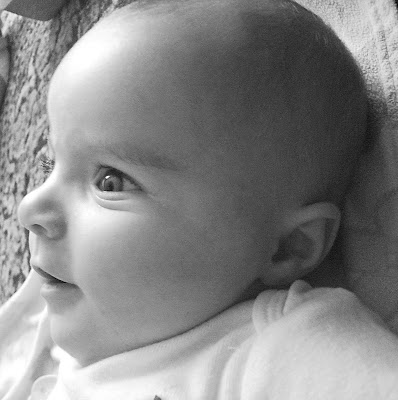
This series of pictures should show you a little more clearly what Addy's case of craniosynostosis looks like. The probable closure is the right coronal suture (going from the middle of the head down to the right ear).

Here she is! Ain't she a cutie?

Below is her "concerned" face. This look was even more exaggerated when she was first born. You'll noticed that the left side of the head (on your right in this picture) looks slightly larger than the other, the right eyebrow looks higher, and the left eye is slightly deviated from the other one. My pediatrician seems to think the eye deviation may be because there is pressure on her optic nerve, but a surgeon's assistant with whom I spoke seemed to think this was unlikely because of where the optic nerve is in the brain. I'm not sure who to believe on that matter.


Left side of the face -- looks normal and cute

Right side of the face

You may notice this side of her face looks fairly different than the other. You may also see the slight bump in the middle of her head, showing where (I believe) the front bone is slightly overlapping the back.

Here you can see that the left side of the forehead is definitely positioned further out than the right side.


Even more clearly here...

This is most obvious from the angle of looking down on her head, as in the picture below. Notice you can actually see her right eye from this angle, but you can't see the left eye. The forehead is retracted on the right side like this because the fused bone has not allowed it to expand forward as it should. (Compare this to the craniosynostosis photo in this post, and you will see why I said that picture looked like Addy.)


Back of the head -- note the left side is bigger than the right here too

She still is pretty darn cute for having a crooked head, though, isn't she? :-)

Being silly

We love you, little sweetie pie!